
Repair or Retire: Board-Level Economics on a KAS Machine
A failed hash board turns a mining plan into a repair quote, and the quote needs a yardstick. At 500 TH/s a 0.1 BTC goal takes 445.8 days on the 21 September 2026 network total, which is 0.00022433 BTC a day, or $19.00 at $84,692. A $400 repair is therefore about 21 days of output — a small slice of the schedule if the machine has years left, and a large one if it does not.
Key takeaways
- At 500 TH/s each day of runtime is worth 0.00022433 BTC, or $19.00 at the read-date price.
- A $400 board repair equals about 21 days of that machine's output.
- The 0.1 BTC schedule at the same hash rate is 445.8 days, so the repair is roughly 5% of the plan.
- Retirement becomes rational when the repair costs more than the remaining schedule is worth.
The Question Arrives With a Smell of Burnt Plastic
Board failures rarely announce themselves politely. A fan stops, a board overheats, and the machine reports a fraction of its rated hash rate. The operator then faces a quote for a replacement board, a shipping delay and a decision about whether the machine is still part of the plan.
The instinct is to compare the repair with the price of a new machine. That comparison answers the wrong question. A new machine brings new capacity and a new warranty; a repair restores capacity the operator already owns. The useful comparison is between the repair cost and the coin the repaired machine will produce before it is retired.
What the Remaining Schedule Is Worth
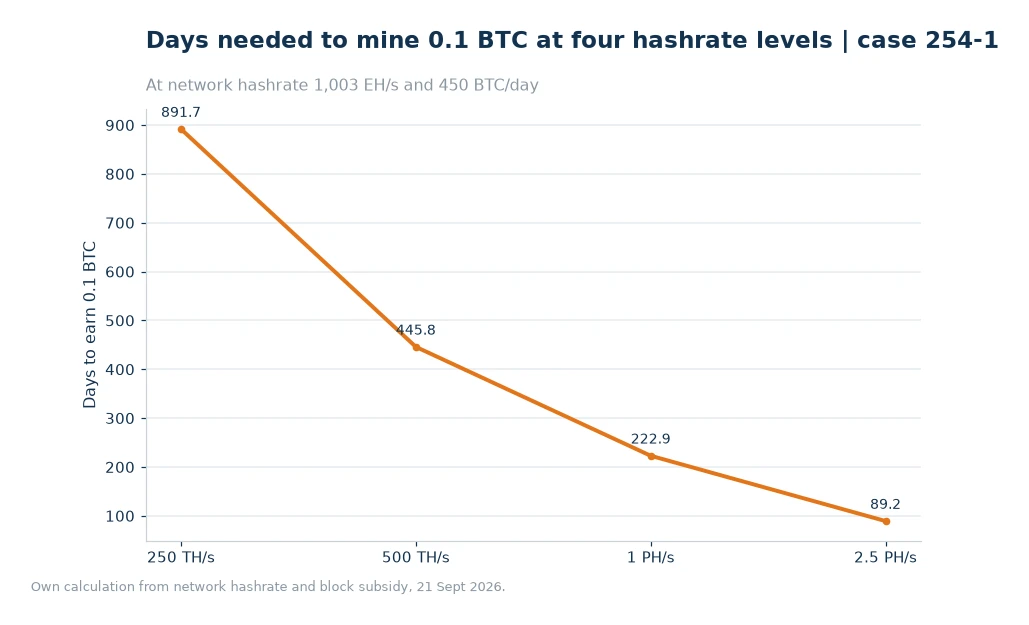
Start with the target the machine was bought to reach. At 250 TH/s a 0.1 BTC goal takes 891.7 days; at 500 TH/s, 445.8; at 1 PH/s, 222.9; at 2.5 PH/s, 89.2. Those figures set the frame. A repair inside a 445.8-day plan is a different proposition from the same repair inside an 89.2-day plan.
The distinction matters because the repair cost is fixed while the remaining schedule shrinks. Late in a plan, the same board costs the same money but buys far less time. That is why an operator should re-run the comparison whenever the finish date moves, rather than relying on the judgement made at purchase. A quote that was obviously worth accepting in month one can be obviously wrong in month twelve.
Costing a Board Swap Against 0.1 BTC
Convert the repair into days of output and the decision becomes arithmetic. At 500 TH/s, a $150 board costs 7.9 days of output, $400 costs 21.1 days and $800 costs 42.1 days. Each figure is the time the repaired machine needs simply to earn back the repair, before it contributes anything to the original target.
The second useful ratio is the repair as a share of the whole schedule. Against 445.8 days, those same repairs are 1.8%, 4.7% and 9.4%. Under 5% is usually easy to absorb. Above 10% the operator should ask whether the machine still belongs in the plan at all, or whether the capital would do more elsewhere.
The Pool Figures That Tell You It Is Worth Fixing
The ViaBTC KAS Mining Pool view tells you two things a repair decision needs: how much of the pool your machine represents, and whether the pool's block discovery has been near expectation. A machine that looks weak during an unlucky stretch may not be weak at all.
Pool Luck is especially relevant on a smaller network, where a run of poor block discovery is more visible in a short window. Before ordering a board, compare the machine's reported hash rate with the pool's view of it. If the reported rate is full and the credit is thin, the fault is variance rather than hardware, and the repair would fix nothing.
For a second opinion on the model itself, the Miner Profitability Ranking shows how the machine sits against current conditions, which is the right input when deciding whether to keep it in service.
KAS Price and the Repair Threshold
At $0.04130647 per KAS the repair thresholds above hold. If the coin's price falls, the dollar value of each day's output falls with it, and the number of days needed to earn back a fixed repair cost rises. A $400 repair that took 21 days at the read-date price would take 42 days if the coin halved, which moves it from comfortable to marginal.
This is why a repair decision should include the price assumption explicitly. The hardware does not care, but the payback does, and the operator is the one carrying the difference.
When Retiring Is the Cheaper Choice
Retirement is not only about repair cost. A machine that has failed once may fail again, and the second failure is not independent of the first. An older board running at the edge of its thermal design will keep producing failures until the operator stops paying for them.
The cleaner test is total remaining cost against total remaining output. Add the repair, the power over the remaining schedule and an allowance for one more failure; compare that with the coin the machine will produce in the same period. When the second number is smaller, retiring is the cheaper choice, even if the machine still turns on. Selling the working parts separately often recovers more than the whole unit would fetch, which is another reason to decide early rather than after a second failure.
| Repair cost | Days of output to recover | Share of the schedule | Verdict at mid-plan |
|---|---|---|---|
| $150 | 7.9 | 1.8% | Repair |
| $400 | 21.1 | 4.7% | Repair |
| $800 | 42.1 | 9.4% | Compare with resale |
| $1,600 | 84.2 | 18.9% | Likely retire |
Worked example
The 500 TH/s machine with a $400 board quote, costed from the pool rate to the schedule.
- Daily issuance: 144 × 3.125 = 450 BTC across 1,003,000,000 TH/s.
- Per terahash: 0.00000044865 BTC; at 500 TH/s that is 0.00022433 BTC a day.
- Value at $84,692: 0.00022433 × 84,692 = $19.00.
- Days to 0.1 BTC: 0.1 ÷ 0.00022433 = 445.8.
- Repair payback: 400 ÷ 19.00 = 21.1 days.
- Share of the schedule: 21.1 ÷ 445.8 = 4.7%.
- At 2.5 PH/s the same machine class reaches 0.1 BTC in 89.2 days, so a $400 repair would be 23.6% of that plan.
- That is the case where the quote should be compared with resale rather than accepted by habit.
Frequently asked questions
How do I decide whether a hash board is worth repairing?
Convert the quote into days of the machine's output and compare that with the days left in the plan. A repair worth less than about 5% of the remaining schedule is usually easy to justify; above 15% the machine should be compared with resale.
Could the fault be the pool rather than the hardware?
Yes, if the reported hash rate is full and only the credit is thin. Check the luck figure before ordering parts, because a run of poor block discovery can mimic a failing board on a smaller network.
Does a KAS price fall change the repair decision?
It changes the payback period. A lower coin price reduces the dollar value of each day's output, so a fixed repair takes longer to earn back and the case for repairing weakens.
Put the Quote Beside the Calendar
Write the repair cost, the daily output and the remaining days in one line. If the first is small against the last, repair and move on. If it is not, the machine has reached the end of its useful plan, and the honest move is to retire it before another failure makes the decision for you.
Keep the record. A folder of quotes and dates turns the next decision into a comparison with history rather than a fresh guess, and it shows clearly when a machine crossed from useful to merely present. The multi-currency wallet records the KAS credited by the machine, which is the other half of that history.
Chain values (1,003 EH/s, 132.76 T, 3.125 BTC per block, 144 blocks a day, BTC $84,692, KAS $0.04130647) were read 21 Sept 2026 from the ViaBTC KAS pool, miner ranking and statistics pages[1]. Repair prices are illustrative. Published 24 Oct 2026.