
The Bottle and Packaging Scope Checklist for a Spa or Hotel Line
On a hotel or spa line, most packaging disputes are scope disputes in disguise. The bottle was specified but the pump was not; the carton was quoted but the label text was nobody's deliverable; the refill system was designed but replacement parts were never priced. A one-page scope checklist, with an owner and a contract line against every item, prevents most of it and costs an hour to assemble.
Key takeaways
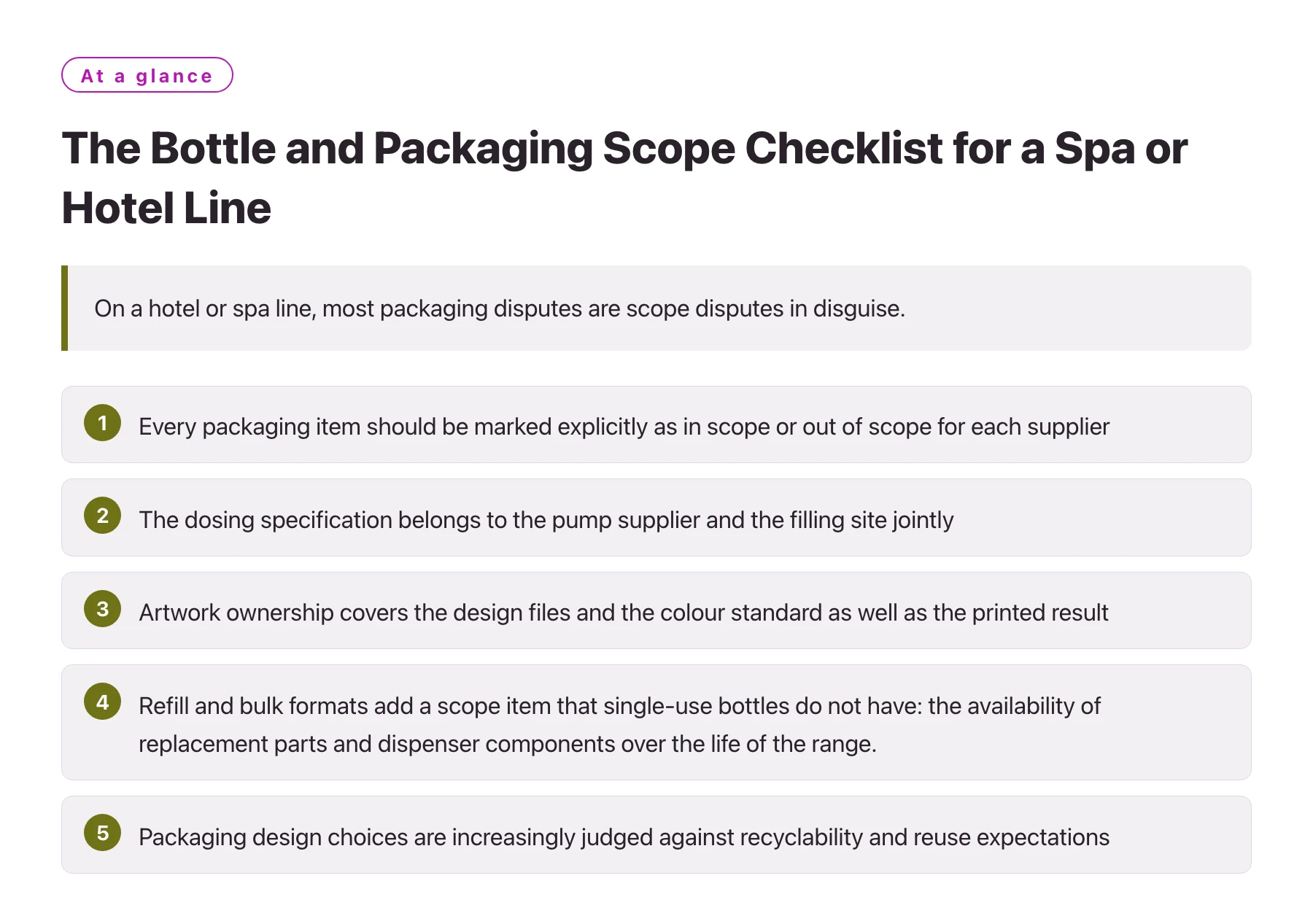
- Every packaging item should be marked explicitly as in scope or out of scope for each supplier, because an item left blank is an item that will be argued about later.
- The dosing specification belongs to the pump supplier and the filling site jointly, which is why it needs a single named owner rather than two assumptions.
- Artwork ownership covers the design files and the colour standard as well as the printed result, and it should be recorded at approval rather than at the end of the project.
- Refill and bulk formats add a scope item that single-use bottles do not have: the availability of replacement parts and dispenser components over the life of the range.
- Packaging design choices are increasingly judged against recyclability and reuse expectations, which turns an end-of-life question into a brief-stage decision [1].
- Design guidance from industry frameworks is a useful reference for those decisions, provided it is applied to the market where the property actually operates [2].
- A distinctive vessel shape can be protected as a registered design, which makes the ownership question commercial rather than administrative [3].
Scope problems are quiet at the start and loud at the end. During the planning stage, everyone assumes the obvious division of labour: the fragrance supplier does the scent, the packaging supplier does the bottle, and the filling site puts the two together. Six months later, a guest-facing print is a shade off and no one can say who approved the colour standard.
The fix is not a longer contract. It is a shorter document that lists the packaging items once and assigns each one. Hotel and spa programmes benefit from this more than retail launches do, because the range usually spans several products, the formats are more varied, and the buying decision often sits with a procurement team rather than with a single product owner.
Use the table below as a working page. Fill in the owner column with a company and a person, add the clause reference from the agreement, and keep it with the purchase order. It is worth seeing how a supplier that handles compounding, decoration and filling itself describes that scope, and a Xuelei fragrance house makes a useful benchmark because the boundary of what it owns is written down rather than assumed.
The scope page, item by item
| Scope item | Usual owner | What the contract should say |
|---|---|---|
| Vessel or bottle supply | Packaging supplier or manufacturer | Whether the component is stock or custom, and who holds the tooling if it is custom |
| Closures, pumps and dispensers | Component supplier, with filling site input | The measured dose, the tolerance, the fill viscosity it was tested with and who verified the combination |
| Decoration and finishes | Decorator or finishing supplier | Process, colour standard, retention of the approved standard, and durability testing against the actual fill |
| Artwork and dielines | Brand owner, executed by the supplier | Who owns the files, who approves revisions, and how the approved version is identified |
| Secondary packaging | Packaging supplier | Carton, label, leaflet or refill pouch, including whether recycled content is required |
| Label content and compliance text | Brand owner, checked against the formula | Which market requirements apply, who drafts the text, and who signs it off before printing |
| Filling and assembly | Manufacturer or filling site | Line used, batch records kept, retained samples taken, and the reference each batch is compared against |
| Testing and inspection | Split by test type | Which tests run, against which fill and packaging combination, who commissions them and who pays for repeats |
| Refill or bulk system parts | Component supplier | Availability of replacement dispensers and spare parts, and the notice period if a part is discontinued |
| Storage, freight and delivery terms | Manufacturer or logistics partner | Incoterms, packaging for transit, and how damage in transit is documented and claimed |
The rows that generate the most disputes on hospitality lines are the second and the ninth. Dosing is a joint responsibility by nature, which means it becomes nobody's responsibility unless it is assigned, and refill parts are an afterthought until the first dispenser fails in a guest bathroom. Both are worth pinning down in writing even when the format seems standard, because the cost of a discontinued part rises sharply once a property has installed a system it cannot replace.
How to use the checklist without turning it into a project
The page is meant to be filled in once and reviewed at three points: when the brief is written, when quotes are compared, and before the first purchase order. Each review takes minutes. The value comes from the comparison, because a supplier that leaves four rows blank is telling you where it expects to stop being responsible.
It also makes quotes comparable. Two proposals can look similar until they are read against the same list, at which point one is pricing decoration, secondary packaging and testing while the other is pricing components and assuming the buyer will handle the rest. Those are not the same offer, and the difference is invisible in the headline unit price.
When one supplier covers more of the page
A manufacturer that compounds the scent, moulds or sources the packaging, decorates it and fills it removes several hand-offs from the list, which reduces the number of interfaces where an item can be dropped. That is the practical argument for fragrance manufacturing under one roof, and it is a stronger argument on a hospitality range than on a simple single-product order, because there are more combinations to keep aligned.
It is not an argument for ignoring the page. Even a single supplier should mark each row in or out of scope, because the boundary is what a dispute is decided on. Consolidation reduces coordination risk; it does not remove the need for a written scope.
What the refill decision adds
Choosing a refillable or bulk format adds a design question to the checklist that single-use formats avoid: the system has to be maintainable. That means parts, not just units. Ask how long the dispenser design is expected to remain in production, how spare parts are ordered, and what the supplier's obligation is if a component changes.
These questions are worth asking before the format is approved, because a property that has installed several hundred dispensers is not in a position to change its mind cheaply. The same reasoning applies to the vessel itself if the shape is distinctive enough to be treated as a design asset rather than a commodity component.
Send the page to every supplier and ask for it back with each row marked in scope, out of scope or jointly owned. What comes back is more informative than a capability brochure: a supplier that returns a completed page, correctly divided, has done this before, and one that returns a single line saying packaging is available has told you that you will be managing the interfaces yourself. The same discipline is worth applying when you compare the broader service model, since what what one-stop scent development covers varies considerably between suppliers.
Sources
- European Commission: Packaging Waste and the PPWR —— EU rules on packaging and packaging waste, including the Packaging and Packaging Waste Regulation requirements on recyclability and design.
- Sustainable Packaging Coalition —— A membership organisation working on more sustainable packaging design, publishing material and recyclability guidance.
- WIPO — World Intellectual Property Organization —— The UN agency for intellectual property; resources on industrial design and patent protection relevant to product and packaging design.
Frequently asked questions
Who should own the pump and closure specification?
The component supplier holds the technical specification, but the filling site has to confirm that the combination works with the actual fill. The practical answer is a single named owner for the verification and a written record of which fill and viscosity was tested, because a pump specified independently of the product is the most common source of dose complaints.
Is it a problem if one supplier handles both packaging and filling?
No, it reduces the number of interfaces where responsibility can be lost, provided the scope is still written down. The risk in a consolidated arrangement is not divided responsibility but unexamined assumptions, so keep the same checklist and have the supplier mark each row in or out of scope.
What should be written down about refill system parts?
Availability of replacement dispensers and components, the expected production life of the design, how spare parts are ordered, and the notice the buyer receives if a part is discontinued. A refill system is a long-term installation rather than a consumable, so these terms matter more than the unit price of the first order.
How often should the scope page be reviewed?
Three times is usually enough: when the brief is written, when quotes are compared against each other, and before the first purchase order is placed. Reviewing it again before a repeat order is cheap insurance, particularly if the format, the market or the artwork has changed since the first run.
Does scope need to cover testing as well as materials?
Yes, and testing is the item most often left to chance. State which tests run, against which combination of fill and packaging, who commissions them and who pays if a repeat is needed because the formula or the format changed. Without that, verification tends to be reduced to whatever the supplier already has on file.